In an increasingly competitive business environment, sales teams must constantly adapt to new strategies, technologies, and client expectations. Traditional training methods, such as classroom sessions, role-playing, or e-learning modules, have long been used to develop sales skills. However, these conventional methods often fall short in delivering practical experience, engagement, and measurable results. As a result, modern sales teams are turning to VR training for sales teams, which leverages virtual reality simulations to provide immersive, hands-on learning experiences that are transforming the way professionals develop their skills.
Understanding VR Training for Sales Teams
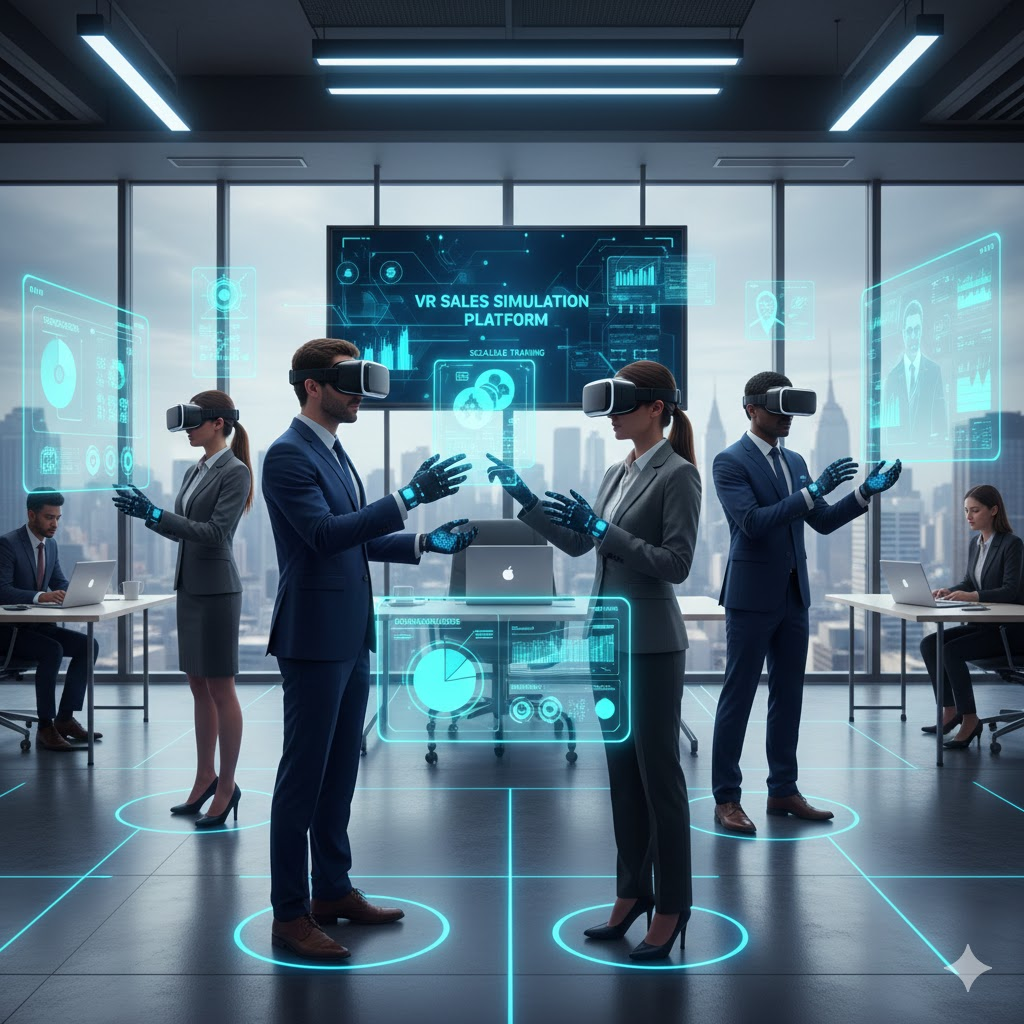
VR training for sales teams uses advanced virtual reality technology to create realistic, interactive environments where employees can practice real-world sales scenarios. Trainees wear VR headsets and engage in simulations that replicate client meetings, product demonstrations, objection handling, and negotiation challenges. Unlike conventional methods, VR provides a safe and controlled space for experimentation, allowing employees to learn by doing rather than simply observing.
By simulating diverse customer interactions and complex sales situations, VR training bridges the gap between theoretical knowledge and practical application. Employees gain firsthand experience, develop confidence, and build critical skills in a risk-free environment.
Limitations of Conventional Sales Training
Traditional sales training methods, while still valuable, often face several challenges. Classroom lectures and online modules can be passive, leading to reduced engagement and retention. Role-playing exercises, although interactive, may feel artificial or limited in scope, providing only a narrow range of scenarios. Additionally, these methods may not fully prepare employees for high-pressure client interactions, as they lack the immersive and realistic experience required to simulate actual sales situations.
Conventional training also struggles with scalability. Coordinating workshops, instructors, and schedules for large or geographically dispersed teams can be costly and logistically complex. Repetition, which is critical for skill mastery, may be impractical due to time constraints and resource limitations.
The Immersive Advantage of VR Simulations
One of the primary reasons modern sales teams are adopting VR simulations is the immersive nature of the training. VR environments fully engage learners by combining visual, auditory, and interactive elements, creating a sense of presence that traditional methods cannot achieve. Employees are placed in lifelike scenarios where every action and decision has immediate consequences, allowing them to experience real-world challenges without the risk of losing clients or making costly mistakes.
This immersive approach enhances retention and understanding. Employees who practice skills in a VR setting are more likely to remember key strategies, objection-handling techniques, and communication nuances. The realism of the simulations ensures that lessons learned translate directly into improved performance in actual sales situations.
Building Confidence and Reducing Performance Anxiety
Confidence is a crucial factor in sales success. Many employees experience anxiety when dealing with difficult clients or high-stakes negotiations. VR training for sales teams allows employees to practice repeatedly in a safe environment, helping them develop confidence and composure. By facing challenging scenarios virtually, trainees can experiment with different approaches, refine their responses, and learn from mistakes without real-world consequences.
This confidence translates into better performance when interacting with actual clients. Employees are more comfortable handling objections, delivering persuasive presentations, and managing complex negotiations, resulting in increased conversion rates and stronger customer relationships.
Measurable Feedback and Performance Tracking
Another advantage of VR simulations over conventional methods is the ability to track performance and provide measurable feedback. VR training platforms often include analytics that monitor decision-making, response times, communication effectiveness, and scenario outcomes. Managers can use this data to identify skill gaps, provide targeted coaching, and measure progress over time.
Unlike traditional workshops, where feedback may be delayed or subjective, VR training delivers immediate, objective insights that help employees continuously improve. This data-driven approach ensures that training is both effective and aligned with organizational goals.
Cost Efficiency and Scalability
Modern organizations also value the cost efficiency and scalability of VR training. Once a VR module is developed, it can be deployed across multiple locations and for large teams without additional instructor or travel costs. Employees can access simulations on demand, allowing training to fit within existing schedules and reducing downtime. Repetition and practice are easily achievable, ensuring that all team members reach a consistent level of proficiency.
This scalability makes VR training ideal for growing businesses or organizations with distributed sales teams, enabling consistent skill development across the entire workforce.
Conclusion
Modern sales teams are increasingly choosing VR simulations over conventional training methods due to the immersive, engaging, and practical experiences they provide. VR training for sales teams allows employees to practice real-world scenarios safely, build confidence, retain knowledge more effectively, and receive measurable feedback to improve performance. Unlike traditional workshops, VR simulations offer scalability, consistency, and an unparalleled level of engagement, making them a strategic investment for organizations seeking to elevate sales performance and drive revenue growth. By embracing VR training, companies ensure that their sales teams are better prepared, adaptable, and equipped to succeed in today’s competitive marketplace.
Discover how VR training can elevate your sales team’s performance. Explore Mazerspace’s immersive VR solutions and transform the way your employees learn and succeed here: https://mazerspace.com/
